
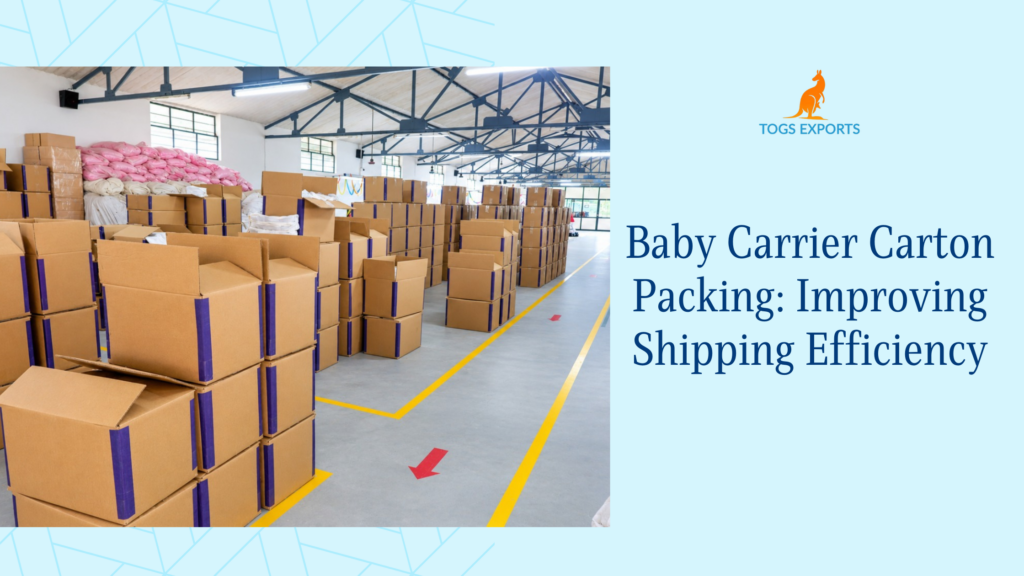
For baby carrier brands importing products in bulk, carton packing affects shipping volume, storage efficiency, handling, and overall logistics costs. Baby carrier carton packing should be planned around the finished product, approved retail packaging, carton dimensions, and shipment requirements before bulk production begins.
Poor carton planning can lead to wasted space, inconsistent carton weights, difficult handling, or unnecessary packaging costs. On the other hand, a well-defined packing specification helps brands organise shipments, estimate container utilisation, and communicate requirements clearly with their manufacturing partners.
As part of baby carrier manufacturing, carton planning connects product development and packaging decisions with the practical requirements of international distribution.
Why Baby Carrier Carton Packing Matters for Export Orders
Baby carriers can include padded body panels, shoulder straps, waist belts, buckles, webbing, and storage accessories. These components affect how the finished product folds and fits inside its retail package.
When brands order in bulk, the dimensions and quantity of individual packages influence the size and number of shipping cartons required.
Effective carton planning helps with:
- Shipping efficiency: Appropriate carton dimensions can reduce unnecessary empty space.
- Freight planning: Carton measurements and shipment quantities help logistics teams estimate shipping volume.
- Warehouse organisation: Standard carton sizes and clear identification make handling and storage more manageable.
- Product protection: Suitable packing arrangements help reduce unwanted movement and damage during transit.
- Order accuracy: Defined units per carton make quantity verification easier during packing and receiving.
The most efficient carton is not necessarily the smallest one. It must accommodate the packaged product without excessive compression and remain suitable for the intended transport and handling conditions.
Key Factors in Baby Carrier Carton Packing
Before selecting export carton dimensions, brands and manufacturers should evaluate the product and its packaging configuration.
Product design and folded dimensions
Different baby carrier styles have different packing requirements. A soft baby wrap may fold into a relatively compact package, while a structured carrier with padding and a waist belt may require more space.
The packed dimensions should be measured using the approved folding method. Measurements from an unfolded product do not provide a reliable basis for finalising carton size.
Retail packaging dimensions
If each carrier is packed in a retail box or individual protective package, the outer carton must accommodate those packages in a defined arrangement.
The packing team should confirm the dimensions of the actual approved packaging, including any inserts, instruction booklets, or accessories that affect the final size.
Units per carton
The number of units packed in each carton influences carton dimensions, gross weight, handling, and storage.
Increasing the quantity per carton may reduce the number of cartons required, but it can also create heavier packages or increase the risk of product compression. The appropriate quantity depends on the packaged product and handling requirements.
Carton material and construction
Carton strength should suit the packed weight, stacking arrangement, transport conditions, and expected handling. The selected board grade and carton construction should be appropriate for the intended shipment.
A carton that is too weak may deform under load, while unnecessarily heavy packaging can add material and shipping weight.
Destination and shipping method
Air freight, sea freight, courier services, and domestic transport may have different dimensional and weight considerations. Brands should confirm the applicable carrier rules and packing requirements before finalising the carton specification.
Calculating Carton Dimensions and Shipping Volume
Export carton planning begins with accurate measurements of the individual package and the intended carton arrangement.
The internal carton dimensions need to accommodate the packed products. The external dimensions are then used for shipping calculations, subject to the carrier’s requirements.
A simple volume calculation is:
Carton volume = Length × Width × Height
When dimensions are measured in centimetres, divide the result by 1,000,000 to convert cubic centimetres into cubic metres.
For example, a carton measuring 60 cm × 40 cm × 40 cm has a volume of:
60 × 40 × 40 = 96,000 cubic centimetres
96,000 ÷ 1,000,000 = 0.096 cubic metres (CBM)
This calculation gives the carton’s external or internal volume depending on which dimensions are used. For freight planning, use the external dimensions required by the logistics provider.
The final shipping charge may also depend on actual weight, dimensional or volumetric weight, route, and carrier rules. Carton volume alone does not determine the total freight cost.
Example of Carton Packing Planning
The following example illustrates how carton configuration can affect shipment planning. These figures are hypothetical and do not represent Togs Exports’ standard packing specifications.
| Packing detail | Example |
|---|---|
| Individual package dimensions | 30 × 20 × 10 cm |
| Individual package volume | 0.006 CBM |
| Units per carton | 10 |
| Carton external dimensions | 60 × 40 × 40 cm |
| Carton external volume | 0.096 CBM |
| Total units in 20 cartons | 200 |
The combined volume of ten individual packages is 0.06 CBM before accounting for the space required by the carton structure, arrangement, and packing clearances. The example carton has an external volume of 0.096 CBM.
This difference illustrates why brands should not simply multiply the individual package volume and assume that the result equals the shipping carton volume. The actual carton layout, package orientation, internal clearances, and board thickness all influence the final dimensions.
Improving Carton Space Utilisation
Carton optimisation means using available space effectively while protecting the products and keeping packages manageable.
Standardise the folding method
A consistent folding procedure helps make package dimensions more predictable. If different operators fold the same carrier differently, the number of units that fit inside a carton may vary.
The folding method should be documented and checked during sample packing.
Arrange packages systematically
Before approving the carton, test practical arrangements for the individual packages. Consider their orientation, the number of layers, and whether the selected configuration allows products to fit without excessive pressure.
The arrangement should be repeatable during bulk packing rather than relying on an improvised layout.
Avoid unnecessary empty space
Oversized cartons may increase shipping volume and allow products to move during transit. Review whether carton dimensions can be adjusted without compromising product protection or stacking performance.
However, reducing empty space should never create excessive pressure on padded panels, buckles, or other components.
Review mixed-SKU packing carefully
Some brands may want different colours, sizes, or models packed together. Mixed-SKU cartons can help suit certain order requirements, but they also create additional complexity in quantity verification and warehouse receiving.
Each mixed carton should follow a documented packing plan that identifies the included models, quantities, and product references.
Coordinate carton planning with order quantities
The total order quantity should be reviewed against the approved units-per-carton configuration. If the order does not divide evenly into full cartons, the team should agree on how the remaining units will be packed and labelled.
This helps avoid unexpected carton counts or confusion during shipment preparation.
Carton Weight and Handling Requirements
Carton planning should account for gross weight as well as volume.
Gross carton weight includes the products, individual packaging, inserts, and outer carton. Brands and manufacturers should calculate or verify this weight using the final packing configuration.
An appropriate carton weight helps support safe manual handling and compliance with any applicable carrier or warehouse limits. If a carton becomes too heavy, the packing plan may need smaller quantities per carton.
The team should also consider:
- Carton dimensions and grip during handling.
- The strength of carton closures.
- The stability of cartons during stacking.
- Protection against crushing or deformation.
- Pallet dimensions and the planned stacking arrangement, where applicable.
The correct configuration depends on the shipment and distribution environment. A packing arrangement suitable for one route or warehouse may not be appropriate for another.
Protecting Baby Carriers During Transit
Shipping efficiency should not come at the expense of product protection.
Baby carriers contain multiple components that can shift or become compressed during transport. Carton packing should maintain the approved folded arrangement and limit unnecessary movement.
Practical controls include:
- Using the approved individual packaging.
- Following the documented folding and placement sequence.
- Keeping accessories and instruction materials in their designated positions.
- Selecting carton construction suitable for the packed weight.
- Closing cartons according to the agreed packing instructions.
- Inspecting representative packed cartons before shipment.
Where shipment conditions justify additional testing, brands can evaluate the packaging configuration through suitable transit or distribution tests.
A carton that appears satisfactory when empty may behave differently when filled and stacked. Therefore, the complete packing arrangement should be reviewed rather than relying on carton appearance alone.
Common Baby Carrier Carton Packing Mistakes
Several planning mistakes can create avoidable delays and costs.
Finalising carton dimensions too early
If the product folding method or retail package changes after carton approval, the existing carton may no longer fit the product efficiently. Confirm the finished package dimensions before approving the export carton.
Calculating volume using the wrong measurements
Internal carton dimensions are useful for checking fit, but freight calculations commonly require external dimensions. Confirm which measurements the logistics provider expects.
Packing too many units into one carton
A higher unit count may reduce the number of cartons, but it can increase gross weight and compression risk. Evaluate both handling and product protection before increasing carton quantities.
Ignoring carton weight
A carton may fit the products correctly but still be unsuitable for the intended handling process because of its weight. Verify gross weight as part of the packing specification.
Failing to document the packing arrangement
Without clear instructions, different packing teams may use different folding methods or carton quantities. A documented packing standard helps maintain consistency.
Overlooking shipment-specific requirements
Customer instructions, pallet configurations, shipping marks, and carrier restrictions may affect the final carton design. Confirm these details before bulk packing begins.
Baby Carrier Export Carton Packing Checklist
Before approving carton packing for an export order, brands can use this checklist:
-
Final product and individual packaging dimensions confirmed.
-
Folding method documented and approved.
-
Units per carton established.
-
Internal carton dimensions checked against the packing arrangement.
-
External dimensions recorded for freight planning.
-
Gross carton weight verified.
-
Carton material and construction reviewed.
-
Product movement and compression risks considered.
-
Mixed-SKU requirements documented, where applicable.
-
Carton markings and shipment identification confirmed.
-
Packing sample inspected before bulk packing.
-
Final carton configuration recorded in the shipping specification.
This checklist helps establish a shared packing reference for the brand, manufacturer, packing team, and logistics provider.
The Role of Carton Planning in Baby Carrier Manufacturing
Carton packing connects the finished product with the practical requirements of export preparation. It depends on product dimensions, packaging design, order quantities, carton strength, and shipment arrangements.
For OEM and private-label brands, early carton planning can make shipment estimates more reliable and help prevent last-minute packaging changes.
At Togs Exports, baby carrier manufacturing includes coordinating product specifications, sample development, packaging requirements, and production preparation. Brands can discuss their preferred units per carton, packaging format, and export requirements during product development so these details can be considered before shipment planning.
Frequently Asked Questions
1. What is baby carrier carton packing?
Baby carrier carton packing is the process of arranging packaged baby carriers into shipping cartons according to defined quantity, dimensions, weight, and protection requirements.
2. How do brands calculate export carton volume?
Multiply the carton’s length, width, and height. If measurements are in centimetres, divide the result by 1,000,000 to convert cubic centimetres into cubic metres. Use external dimensions when required for freight calculations.
3. How many baby carriers should be packed in one carton?
There is no universal quantity. The number depends on the individual package dimensions, carrier design, carton strength, gross weight, and shipping requirements. The final configuration should be confirmed through packing trials.
4. How can brands reduce shipping volume for baby carriers?
Brands can review folding methods, individual package dimensions, carton arrangements, and units per carton. Any optimisation should maintain product protection and meet the relevant handling and carrier requirements.
5. What information should an export carton specification include?
It should generally include carton dimensions, material or construction details, units per carton, gross weight, packing arrangement, carton markings, and any customer-specific shipping instructions.
Plan Your Baby Carrier Export Requirements With Togs Exports
Efficient carton packing starts with accurate product dimensions and a clear packing specification. Togs Exports supports OEM, ODM, and private-label baby carrier development for international brands, with packaging and production requirements considered as part of the wider manufacturing process.
Phone: +91 99447 50075
Website: www.togsexports.com