
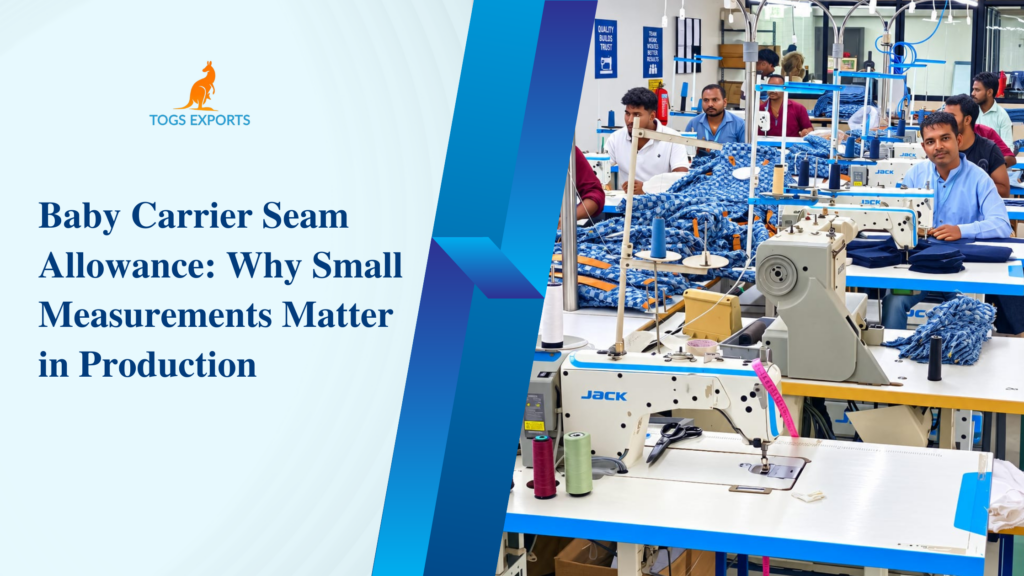
In baby carrier manufacturing, a few millimetres can influence how fabric panels align, how seams sit, and how consistently a product can be assembled. Baby carrier seam allowance is an important part of pattern development because it defines the fabric width reserved beyond a stitching line. When manufacturers and brands establish clear seam specifications, they can improve assembly consistency, reduce avoidable rework, and maintain the intended product dimensions.
For OEM and private-label brands, seam allowance should be considered during product development rather than left to individual operators during production. Different components may require different construction approaches, depending on the fabric, seam type, product design, and functional requirements.
As part of baby carrier manufacturing, pattern measurements and stitching specifications need to work together so the approved design can be reproduced consistently during bulk production.
Understanding Baby Carrier Seam Allowance
Seam allowance is the distance between the fabric’s cut edge and the intended stitching line. It provides the material needed to construct a seam and secure the joined fabric pieces.
For example, if a pattern specifies a 10 mm seam allowance, the fabric extends 10 mm beyond the designated stitching line. The actual allowance used in production depends on the component, seam construction, material behaviour, and approved technical specification.
In baby carrier development, seam allowance may vary across:
- Main body panels
- Shoulder straps
- Waist belt components
- Pockets and overlays
- Lining and padding assemblies
- Binding and edge-finished sections
A single allowance should not automatically be applied to every part of a carrier. The specification should reflect the requirements of each seam and assembly.
Why Seam Allowance Matters in Baby Carrier Manufacturing
Seam allowance affects more than the amount of fabric used during stitching. It also influences the accuracy and repeatability of the finished product.
Finished dimensions and fit
When seam allowances differ from the approved pattern, the finished dimensions may change. This can affect panel proportions, the position of seams, and the alignment of connected components.
For example, if a body panel uses a different allowance from the approved specification, its finished dimensions may vary. Repeated deviations across several seams can create a noticeable difference between the production sample and the approved reference.
Seam construction and consistency
The correct allowance provides the intended material width for the selected seam construction. An allowance that is too narrow for the specified construction may make assembly difficult, while an unnecessarily wide allowance can create excess bulk or require additional finishing.
The appropriate measurement depends on the seam design and the materials involved. It should be confirmed through product development and sampling.
Material usage and production efficiency
Seam allowance influences pattern dimensions and fabric consumption. Inconsistent allowances can also increase trimming, handling time, and rework.
A documented specification helps pattern makers and production teams work from the same reference. This supports more predictable material planning without compromising the intended construction.
Appearance and edge finishing
Seam allowance can affect how neatly fabric edges are enclosed, bound, or finished. If the allowance is inconsistent, the finished seam may show uneven edges, puckering, or variations in bulk.
These issues are particularly relevant when a design combines different fabrics, lining materials, padding, and binding.
Factors That Determine the Right Seam Allowance
There is no single seam allowance that suits every baby carrier component. Manufacturers should consider several factors before finalising the pattern.
Fabric thickness and structure
Lightweight woven fabric, knitted fabric, padded assemblies, and thicker multilayer constructions can behave differently during stitching.
The selected allowance should provide enough material for the specified seam without creating unnecessary bulk. Testing the actual material combination helps confirm whether the pattern and construction work together.
Seam type and construction method
Plain seams, bound seams, reinforced seams, and other construction methods have different requirements. A seam that includes binding or multiple layers may need a different pattern arrangement from a simple joined seam.
The technical specification should identify the intended construction rather than provide a measurement without context.
Component function
A decorative overlay and a load-bearing strap assembly do not have identical construction requirements. Components involved in carrying loads or supporting adjustment features need particular attention to their specified seam construction and reinforcement.
Seam allowance alone does not establish seam strength or product safety. These must be evaluated through appropriate construction reviews and applicable testing.
Pattern accuracy and production method
The pattern must clearly distinguish the stitching line, cutting line, notches, folds, and any other relevant construction references.
When the pattern is unclear, operators may interpret the measurements differently. A complete pattern and sewing specification help reduce variation between operators and production batches.
Seam Allowance and Pattern Accuracy
Baby carrier pattern accuracy depends on the relationship between the finished measurements, stitching lines, cutting lines, and construction details.
A pattern should clearly show whether the seam allowance is already included in the cutting dimensions. Otherwise, a pattern maker or production team may add the allowance twice or omit it entirely.
For example, a finished panel dimension of 300 mm does not automatically mean the cutting dimension should also be 300 mm. The required cutting dimensions depend on the seam allowances, folds, binding, and other construction details specified for that panel.
A controlled pattern-development process should include:
- Confirming the intended finished dimensions.
- Defining the seam construction for each relevant edge.
- Adding the appropriate allowance to the cutting pattern.
- Marking stitching lines, notches, and alignment points.
- Producing a sample using the specified construction.
- Checking the finished measurements and seam appearance.
- Revising and approving the pattern before bulk production.
This process helps translate the design into a repeatable manufacturing specification.
Common Seam Allowance Problems and Their Effects
The following examples show how seam-related inconsistencies can affect production.
| Problem | Possible effect | Recommended control |
|---|---|---|
| Inconsistent seam allowance | Uneven finished dimensions | Use a controlled pattern and clear measurement references |
| Allowance too narrow for the specified construction | Difficult assembly or inadequate material for the intended seam | Review the seam design and validate it through sampling |
| Excessive allowance | Unnecessary bulk or additional finishing work | Confirm allowance against the selected construction |
| Incorrect cutting-line interpretation | Panels may finish larger or smaller than intended | Label cutting and stitching lines clearly |
| Poor alignment between panels | Twisting, puckering, or uneven seams | Use notches and defined alignment points |
| Unapproved pattern changes | Differences between approved samples and bulk products | Document revisions and control pattern versions |
These problems may have different causes, so corrective action should address the underlying issue rather than simply increasing or decreasing every seam allowance.
Seam Allowance Checks Before Bulk Production
For OEM buyers, a practical seam review during sample approval can help identify inconsistencies before production quantities increase.
Pattern and measurement review
Confirm that the pattern includes the intended seam allowances and clearly identifies finished dimensions. Check whether allowances vary by component and whether each variation has a defined reason.
Sample construction review
Inspect the sample for consistent seam widths, alignment, edge finishing, and unwanted bulk. Compare the assembled product against the approved design and measurement sheet.
Stitching specification review
Confirm that the sewing instructions identify the intended seam construction and any relevant reinforcement or finishing requirements. Critical construction details should not depend solely on verbal instructions.
Revision control
When a pattern or sewing method changes, update the relevant documentation and identify the approved revision. This helps prevent production teams from using outdated specifications.
Production consistency checks
During manufacturing, check representative components against the approved pattern and construction standard. If variation appears, investigate whether it comes from cutting, pattern interpretation, material handling, or stitching.
Seam Allowance, Reinforcement, and Product Quality
Seam allowance is one element of seam construction, but it should not be confused with reinforcement or seam strength.
A wider allowance does not automatically create a stronger seam. Strength and durability depend on several factors, including fabric properties, thread, stitch type, stitch density, seam design, reinforcement, and workmanship.
For baby carriers, the intended construction should be reviewed according to the function of each component. Areas that support straps, adjustment systems, or other load-bearing features may require specific reinforcement and appropriate product-level evaluation.
Brands should define these requirements in their technical specifications and verify the finished construction through suitable inspection and testing. No single seam measurement can guarantee the overall safety or durability of a carrier.
Building Seam Specifications Into Baby Carrier Development
A consistent manufacturing process starts with clear communication between the brand and its manufacturing partner. The technical pack should provide enough information for pattern development, sample construction, and bulk production without relying on assumptions.
Useful documentation includes:
- Approved pattern measurements and revision details
- Defined seam allowances by component where necessary
- Cutting-line and stitching-line references
- Seam construction and finishing instructions
- Relevant reinforcement details
- Sample inspection and measurement records
- Approval notes for any design or construction changes
At Togs Exports, baby carrier manufacturing involves coordinating product specifications, sample development, pattern details, and production requirements. For brands developing custom or private-label carriers, clearly defined seam requirements can help align the approved design with the intended manufacturing process.
Frequently Asked Questions
1. What is baby carrier seam allowance?
Baby carrier seam allowance is the fabric width between the cutting edge and the intended stitching line. It provides the material needed to construct the specified seam.
2. Is the same seam allowance suitable for every baby carrier component?
No. The appropriate allowance depends on the fabric, component, seam type, construction method, and finished dimensions. Different parts may require different specifications.
3. How does seam allowance affect finished carrier dimensions?
If the allowance differs from the approved pattern, the finished dimensions may change. This can affect panel proportions, seam alignment, and consistency between samples and bulk production.
4. Does a wider seam allowance make a baby carrier stronger?
Not necessarily. Seam strength depends on the complete construction, including fabric, thread, stitch type, reinforcement, and workmanship. The allowance should suit the specified seam design.
5. What should OEM buyers check before approving a baby carrier sample?
OEM buyers should review the pattern measurements, seam consistency, edge finishing, alignment, reinforcement details, and compliance with the approved technical specification before authorising bulk production.
Develop Your Baby Carrier With Togs Exports
Clear pattern specifications and consistent seam construction help brands move from product concept to repeatable manufacturing. Togs Exports supports OEM, ODM, and private-label baby carrier development, including customised product requirements and sample development.
Phone: +91 99447 50075
Website: www.togsexports.com
READ MORE: