
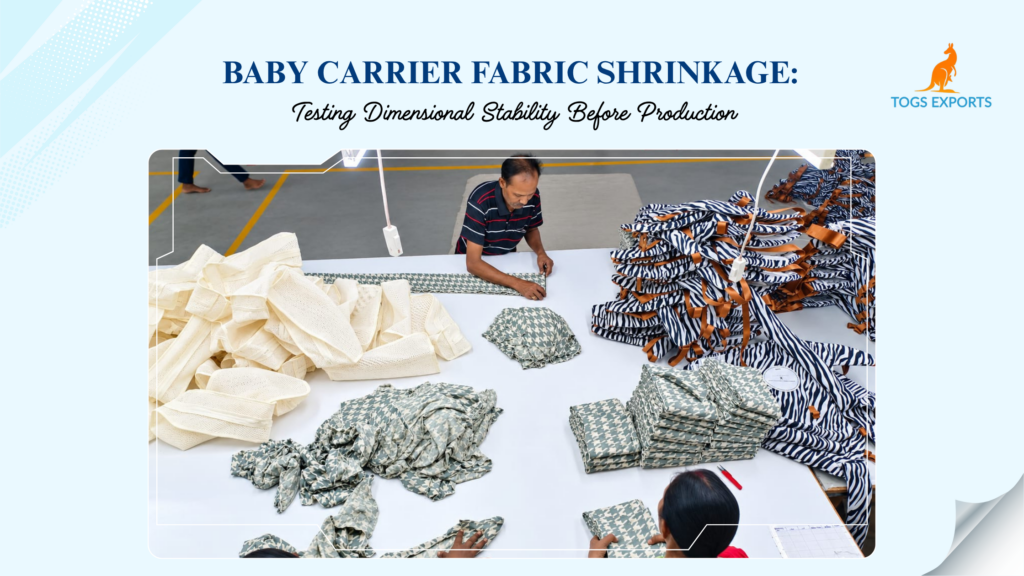
A fabric can meet every measurement on the specification sheet and still change after washing or finishing. A panel that measures correctly before processing may become shorter, narrower, or slightly distorted afterward. For a baby carrier brand, these changes can affect the finished dimensions, appearance, and consistency of the product.
Baby carrier fabric shrinkage is an important consideration when developing a new carrier or preparing materials for bulk production. Understanding how a fabric responds to washing, moisture, heat, and finishing helps brands make better material decisions before committing to a production run.
For businesses involved in baby carrier manufacturing, dimensional stability should be evaluated during material approval rather than treated as a problem to fix after the carriers have been assembled.
What Baby Carrier Fabric Shrinkage Means
Fabric shrinkage refers to a reduction in a textile’s dimensions after exposure to specified conditions, such as washing, drying, or finishing.
Shrinkage can occur in two main directions:
- Lengthwise shrinkage: The fabric becomes shorter along its length.
- Widthwise shrinkage: The fabric becomes narrower across its width.
Some fabrics may also distort unevenly, causing panels to lose their intended shape.
The amount of change depends on several factors, including fibre composition, yarn construction, fabric structure, manufacturing tension, finishing, and the care conditions used during testing.
Therefore, baby carrier fabric shrinkage should be evaluated against the actual fabric specification and intended product requirements instead of relying on assumptions about a particular fibre.
Why Shrinkage Matters in Baby Carrier Manufacturing
Fabric dimensions influence more than the size of the finished product. They can also affect how separate panels fit together during assembly.
For example, if one panel changes dimensions more than another, the difference may affect seam alignment, panel symmetry, or the appearance of the completed carrier.
Shrinkage can also influence:
- Finished product measurements
- Pattern accuracy
- Fabric consumption
- Cutting efficiency
- Seam alignment
- Repeat-order consistency
- Product appearance after care
During baby carrier manufacturing, these issues can create additional work if the team discovers dimensional changes after cutting or stitching.
Testing the fabric earlier gives the brand and manufacturer a better opportunity to understand its behaviour and adjust the material specification or process where necessary.
What Causes Fabric Shrinkage?
Different fabrics respond differently to moisture, heat, and mechanical action. Understanding the likely causes helps brands choose appropriate testing conditions.
Fibre Composition
Natural fibres and synthetic fibres can behave differently during processing and care. Blended fabrics may also respond differently depending on their composition and construction.
However, fibre type alone does not determine shrinkage. The yarn, fabric structure, finishing, and processing history also influence dimensional stability.
Fabric Construction
Woven and knitted fabrics have different structures, so they may respond differently to washing and drying.
Knitted fabrics can experience dimensional changes related to loop structure and relaxation. Woven fabrics may also shrink or distort depending on yarn characteristics and finishing.
The correct assessment depends on the specific material rather than a general assumption about the fabric category.
Manufacturing Tension
During textile production, yarns and fabrics may experience tension. Some of that tension can relax during later processing or washing.
This relaxation can change the fabric’s dimensions, even when the original material appears stable.
Dyeing and Finishing
Dyeing, heat treatment, washing, compacting, and other finishing operations can influence dimensional stability.
A fabric that has not received suitable finishing may behave differently from one that has undergone a controlled finishing process.
Washing and Drying Conditions
Water temperature, detergent, agitation, drying method, and other care conditions can influence the amount of dimensional change.
For this reason, a shrinkage result is meaningful only when the test method and conditions are clearly recorded.
How Fabric Shrinkage Testing Works
Baby carrier fabric shrinkage testing measures the dimensional change that occurs after a fabric undergoes specified conditions.
A typical laboratory process involves the following steps.
1. Record the Original Measurements
The tester marks or measures defined points on the fabric specimen before testing. The initial length and width provide the reference values.
2. Apply the Specified Test Conditions
The specimen undergoes the washing, drying, or other treatment required by the selected test method.
The conditions should reflect the relevant material specification or product care requirements.
3. Condition the Specimen
After testing, the fabric may need to rest under specified environmental conditions before the final measurements are taken.
This helps create a consistent basis for comparison.
4. Measure the Fabric Again
The tester records the final dimensions and compares them with the original measurements.
5. Calculate the Percentage Change
The percentage shrinkage can be calculated using this formula:
[
\text{Shrinkage (%)} =
\frac{\text{Original measurement} – \text{Final measurement}}
{\text{Original measurement}} \times 100
]
For example, if a fabric measures 100 cm before testing and 98 cm afterward, the shrinkage is 2%.
This example illustrates the calculation only. It does not represent a recommended shrinkage limit for baby carrier fabrics.
Understanding Shrinkage Results
A shrinkage result needs context before a brand can decide whether the fabric is suitable.
Consider a fabric with 2% lengthwise shrinkage and 1% widthwise shrinkage. Whether those results are acceptable depends on the product design, material specification, test method, and agreed tolerance.
A brand should not automatically approve or reject a material based on a single percentage without considering the intended construction.
The results should help answer practical questions:
- Will the fabric remain within the required dimensional tolerance?
- Could the change affect the finished carrier measurements?
- Will different panels behave consistently?
- Does the fabric require additional finishing?
- Should the pattern or cutting plan account for the measured change?
These questions help turn baby carrier fabric shrinkage testing into a useful product-development decision.
Why Pre-Shrunk Fabric May Help
Pre-shrunk fabric has undergone a treatment intended to reduce further dimensional changes under specified conditions.
This can help improve dimensional stability, but the term does not mean the fabric will never shrink.
Brands should still review the fabric’s test results and confirm that the material meets the agreed specification.
The effectiveness of the treatment depends on the fabric type, processing method, and subsequent care conditions.
For baby carrier manufacturing, the important point is to evaluate the actual material after its intended finishing process rather than relying on the term “pre-shrunk” alone.
How Shrinkage Can Affect Pattern Development
Patterns translate the product design into the shapes used for cutting fabric. When the fabric changes dimensions, the manufacturer needs to understand whether those changes affect the intended finished measurements.
For example, if a carrier panel must maintain a specific finished width, the team needs to know how the selected fabric behaves during the relevant processing stages.
However, manufacturers should not automatically increase every pattern dimension by the same percentage.
The correct approach depends on the fabric, direction of shrinkage, construction method, finishing process, and required final measurements.
Testing helps the product development team make informed decisions instead of adding arbitrary allowances.
Shrinkage Testing Before Bulk Production
A successful development sample does not always prove that every incoming fabric batch will behave identically.
Brands should therefore agree on material specifications and appropriate dimensional stability checks before bulk production.
A practical review can include:
| Check | Purpose |
|---|---|
| Fibre composition | Confirms the specified material |
| Fabric construction | Identifies the textile structure |
| Initial dimensions | Establishes the measurement reference |
| Test method | Defines the treatment applied |
| Lengthwise change | Measures dimensional change along the length |
| Widthwise change | Measures dimensional change across the width |
| Acceptance criteria | Defines the agreed limits |
| Test records | Supports material approval and traceability |
For repeat orders, retaining the approved fabric specification and test records helps the team compare incoming materials against the original requirements.
Common Mistakes When Managing Fabric Shrinkage
Assuming All Cotton Fabrics Shrink the Same Way
Fabric behaviour depends on construction, finishing, and processing, not only on fibre composition.
Testing Before Final Finishing
If the production fabric receives additional finishing after testing, its dimensions may change again. The test sequence should match the intended material process.
Measuring in Only One Direction
Lengthwise and widthwise changes can differ. Both directions should be evaluated where relevant.
Ignoring the Care Instructions
A test that does not reflect the intended care conditions may provide limited information about expected product behaviour.
Changing Suppliers Without Reviewing the Material
A similar fabric from a different supplier may have different dimensional stability. Important material changes should trigger an appropriate review.
Avoiding these mistakes helps brands manage baby carrier fabric shrinkage before it creates problems in production.
A Practical Fabric Shrinkage Checklist for OEM Buyers
Before approving the material, brands can confirm:
-
Fibre composition documented
-
Fabric construction identified
-
Finishing process confirmed
-
Appropriate test method selected
-
Initial measurements recorded
-
Lengthwise shrinkage assessed
-
Widthwise shrinkage assessed
-
Acceptance limits agreed
-
Final material specification documented
-
Relevant test records retained
-
Pattern and cutting requirements reviewed
-
Material changes assessed before repeat production
This checklist helps connect fabric testing with the decisions that happen on the manufacturing floor.
How Togs Exports Approaches Fabric Development
At Togs Exports, material selection forms part of the wider product development process for international brands. The selected fabric needs to suit the carrier design, construction requirements, approved measurements, and intended production process.
Understanding baby carrier fabric shrinkage can help brands and manufacturers discuss material performance before moving into bulk production.
As a baby carrier manufacturer and exporter, Togs Exports supports customized product development, sampling, OEM and ODM production, and private-label manufacturing.
For brands planning baby carrier manufacturing, the objective is not simply to find a fabric that looks right when it arrives. It is to understand how that material behaves during processing and how its dimensional stability affects the finished product.
A little testing before production can provide valuable information for making better material and pattern decisions.
FAQs
1. What is baby carrier fabric shrinkage?
Baby carrier fabric shrinkage is the reduction in fabric length or width after exposure to specified conditions, such as washing, drying, or finishing.
2. How is fabric shrinkage calculated?
Shrinkage is calculated by subtracting the final measurement from the original measurement, dividing the difference by the original measurement, and multiplying by 100.
3. Does pre-shrunk fabric eliminate shrinkage completely?
No. Pre-shrinking aims to reduce dimensional changes, but the fabric may still shrink under certain conditions. The actual material should meet the agreed specification.
4. Why should fabric shrinkage be checked before baby carrier production?
Testing helps identify dimensional changes that could affect finished measurements, panel alignment, cutting, construction, and consistency between production batches.
5. What is an acceptable shrinkage percentage for baby carrier fabric?
There is no universal percentage for every carrier fabric. The acceptable limit depends on the material, product design, intended care conditions, and agreed manufacturing specification.