
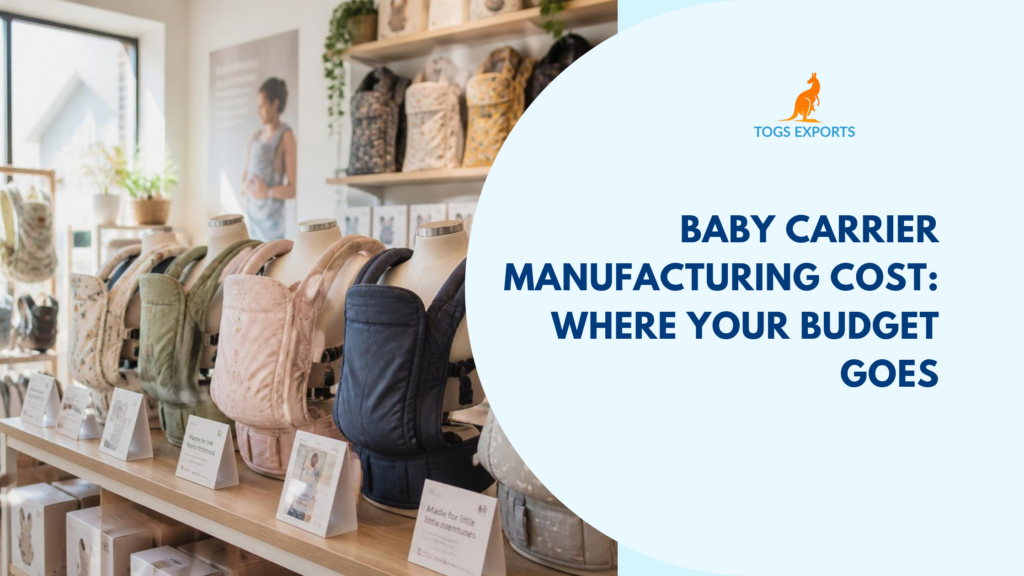
A baby carrier may look like a relatively simple product, but its final manufacturing cost comes from many individual decisions. Fabric, webbing, buckles, padding, stitching, packaging, labour, quality control, and order quantity can all influence the final price.
Understanding baby carrier manufacturing cost helps private label brands build a realistic budget before they move from product development to bulk production. Instead of asking only, “What is the price per carrier?”, buyers can look at what actually creates that price and identify where they can optimize without compromising the product.
For brands entering baby carrier manufacturing, this approach makes supplier discussions clearer and helps prevent unexpected costs later in the development process.
What Determines Baby Carrier Manufacturing Cost?
There is no universal price for a baby carrier.
Two carriers can look similar but have very different production costs because they use different materials, construction methods, hardware, packaging, and quality requirements.
The main cost factors usually include:
- Fabric and other materials
- Webbing and hardware
- Padding and reinforcement
- Pattern and product development
- Labour and assembly
- Sampling
- Quality control
- Testing requirements
- Branding and labels
- Packaging
- Order quantity
- Customization
- Shipping and export-related requirements
The important point is that baby carrier manufacturing cost comes from the complete product specification, not from one individual component.
Material Selection Has a Major Impact
Fabric is often one of the most noticeable cost components.
The price can change depending on:
- Fibre composition
- Fabric construction
- GSM
- Fabric width
- Dyeing or printing
- Finishing
- Colour
- Special performance requirements
- Order quantity
For example, a standard fabric and a customized printed fabric may have very different costs.
Likewise, a brand requesting a specific organic, recycled, or specialty textile may need to account for additional sourcing or certification requirements.
However, choosing the cheapest fabric does not necessarily reduce the overall product cost in a useful way.
If the material does not perform well during cutting, stitching, washing, or final use, the brand may face additional sampling, rejection, or production problems.
Hardware and Webbing Add More Than Their Unit Price
Buckles, adjusters, rings, clips, and webbing may look like relatively small components, but a carrier can use several of them.
The total cost depends on:
- Component type
- Size
- Material
- Finish
- Colour
- Quantity per carrier
- Customization
- Required specifications
- Sourcing volume
Baby Carrier Webbing also needs to match the carrier design and hardware.
A wider or specialized webbing can cost more than a standard option. At the same time, changing the webbing after sample approval can create additional development work if the new specification affects buckle compatibility or construction.
Therefore, brands should finalize important component specifications before calculating the final production budget.
Product Complexity Influences Labour Cost
A simple carrier and a highly customized carrier do not require the same amount of production work.
A product with:
- Multiple adjustment systems
- Several fabric layers
- Complex padding
- Reinforced attachment points
- Additional pockets
- Decorative stitching
- Multiple accessories
- More detailed finishing
can require more production time.
During baby carrier manufacturing, labour cost is therefore connected to the number of operations required to produce the finished product.
Reducing unnecessary complexity can sometimes lower production cost, but the goal should be to simplify the construction without weakening the product’s intended functionality or appearance.
Customization Changes the Cost Structure
Private label brands often want their carrier to look and feel different from standard products.
Customization may include:
- Custom fabric
- Custom colours
- Printed patterns
- Brand labels
- Embroidery
- Custom webbing
- Special buckles
- Unique packaging
- Additional accessories
- Modified dimensions
- Custom product features
Each change can introduce additional development or sourcing requirements.
For example, changing the colour of an existing product may be relatively straightforward, while creating a completely new construction may require pattern development, several samples, material trials, and additional approvals.
That is why brands should separate product customization from simple branding when evaluating baby carrier manufacturing cost.
Sampling Is Part of the Development Budget
A common mistake is to think about cost only after the product is ready for bulk production.
However, product development can involve:
- Initial sample
- Revised sample
- Material changes
- Pattern corrections
- Hardware changes
- Fit adjustments
- Packaging sample
- Pre-production sample
Each revision can involve materials and manufacturing time.
This does not mean brands should avoid revisions. Quite the opposite.
Good sampling can identify problems before bulk production, potentially preventing much larger costs later.
The key is to plan for product development instead of treating every sample revision as an unexpected expense.
MOQ Can Affect Unit Cost
Order quantity is another important factor.
A manufacturer needs to source materials, plan production, prepare machines, organize labour, and manage quality checks.
When the order quantity increases, some fixed production and sourcing costs can be distributed across more units.
However, a higher MOQ is not automatically better for every brand.
A new private label company may prefer a smaller initial order to test its market before committing to a larger quantity.
The better approach is to evaluate the relationship between:
MOQ + unit cost + inventory risk + expected demand.
A lower unit price is not useful if the brand ends up holding more inventory than it can sell.
Packaging Can Change the Final Budget
Packaging is another cost that brands sometimes overlook.
The total packaging cost can include:
- Retail box
- Printed carton
- Fabric bag
- Polybag or alternative protective packaging
- Hangtag
- Instruction manual
- Barcode labels
- Inner packaging
- Outer cartons
Packaging also affects shipping volume.
A slightly larger retail box may increase the size of the outer carton, reduce the number of units packed per carton, and increase shipping volume.
Therefore, baby carrier packaging specifications should be considered alongside the product rather than calculated separately at the end.
Quality Control Is Part of the Cost, Not an Extra
Quality control requires time and resources.
Depending on the manufacturing process, checks may happen during:
- Incoming material inspection
- Cutting
- Sewing
- Assembly
- Hardware attachment
- Finished product inspection
- Packing
A structured quality process can identify problems before the products leave the factory.
For brands, this is important because the cost of fixing a production issue after shipment can be much higher than identifying it during manufacturing.
A responsible baby carrier manufacturer should therefore treat quality control as part of production planning rather than something that happens only when a problem appears.
Testing and Compliance Can Add Development Costs
Depending on the destination market and product type, brands may need to consider applicable safety, performance, chemical, labelling, or other regulatory requirements.
For example, ASTM F2236 covers performance requirements, test methods, and marking requirements for soft infant and toddler carriers within its stated scope.
The exact requirements can vary depending on the market and product.
Testing costs should therefore be considered during product development rather than added unexpectedly just before shipment.
More importantly, brands should avoid assuming that a particular fabric, buckle, or GSM automatically makes a carrier compliant. Compliance relates to the finished product and the applicable requirements.
Manufacturing Cost Is Not the Same as Landed Cost
This distinction is especially important for international buyers.
The factory manufacturing price may not include every expense involved in getting the product to the buyer’s warehouse.
A simplified cost structure can look like:
Manufacturing Cost
- Packaging
- Testing or certification expenses where applicable
- Inland transportation
- Freight
- Insurance where applicable
- Customs duties and taxes
- Import-related charges
= Landed Cost
The exact calculation depends on the commercial terms, destination, shipment method, and applicable duties and taxes.
Therefore, buyers should compare suppliers based on the complete purchasing picture rather than looking only at the quoted factory price.
The Cheapest Quote May Not Be the Lowest Cost
Imagine two suppliers quote different prices for the same basic carrier.
Supplier A offers a lower initial price.
Supplier B offers a slightly higher price but includes clearer material specifications, structured quality checks, better sampling support, and more consistent production.
The lower quotation may look attractive initially.
But if the first supplier produces inconsistent materials, requires multiple corrections, or creates quality problems, the actual cost can increase.
For baby carrier manufacturing, buyers should therefore evaluate:
- Product specification
- Material quality
- Sampling process
- MOQ
- Quality control
- Production consistency
- Communication
- Packaging
- Testing requirements
- Delivery planning
Price matters, but it should be evaluated alongside manufacturing capability.
How Brands Can Optimize Manufacturing Cost
Cost optimization does not always mean selecting cheaper materials.
Brands can also reduce unnecessary costs through better planning.
Finalize the Product Specification Early
Frequent changes after production begins can create additional development and material costs.
Choose Materials Based on the Actual Requirement
Avoid over-specifying materials when the additional performance does not provide meaningful value to the product.
Review Product Complexity
Remove unnecessary construction steps if they do not contribute to the product’s function or design.
Plan Packaging Alongside the Product
Efficient packaging can help control both packaging material and shipping volume.
Select MOQ Based on Demand
A balanced order quantity can reduce unit cost without creating excessive inventory.
Build Quality Checks Into Production
Finding problems during manufacturing is generally more manageable than discovering them after shipment.
A Simple Baby Carrier Manufacturing Cost Checklist
Before approving a quotation, brands can review:
- Fabric specifications confirmed
- Webbing and hardware specifications confirmed
- Product construction finalized
- Customization requirements documented
- Sampling costs understood
- MOQ confirmed
- Packaging specifications confirmed
- Testing requirements identified
- Quality control process discussed
- Production timeline confirmed
- Shipping terms understood
- Landed cost estimated
This gives buyers a more realistic picture of the investment required.
What Brands Should Ask a Manufacturer Before Comparing Quotes
Instead of asking only:
“What is your price per piece?”
Ask:
- What materials does the quotation include?
- What customization is included?
- What is the MOQ?
- Is sampling included or charged separately?
- What packaging is included?
- What quality checks are performed?
- Are testing costs included?
- What are the production lead times?
- Which costs are excluded from the quotation?
- What are the payment and shipping terms?
These questions help brands compare suppliers on the same basis.
A Clearer Way to Plan Baby Carrier Manufacturing Cost
There is no single number that defines the cost of manufacturing a baby carrier.
The final figure depends on the product itself.
A customized private-label carrier with premium fabric, specialized hardware, custom packaging, additional accessories, and extensive testing will naturally require a different budget from a simple carrier using standard components.
At Togs Exports, we work with international brands on product development, sampling, OEM and ODM production, private label manufacturing, customization, quality control, and export preparation.
Our approach is to understand the complete product requirement before moving toward production, so brands can make decisions based on the actual specification rather than an isolated price.
For companies planning baby carrier manufacturing, a realistic cost starts with a clear product.
Define the product. Understand the components. Confirm the production requirements. Then compare the cost.
That approach gives brands a much better foundation for building a sustainable product range.
FAQs
1. What affects baby carrier manufacturing cost the most?
Baby carrier manufacturing cost is influenced by fabric, hardware, webbing, product complexity, labour, order quantity, customization, packaging, quality control, testing, and other production requirements.
2. Does a higher MOQ always reduce baby carrier manufacturing cost?
A larger order can sometimes reduce the unit cost by spreading certain sourcing and production expenses across more units. However, brands should balance unit price against inventory requirements and market demand.
3. What is included in the cost of manufacturing a baby carrier?
It depends on the manufacturer’s quotation. Buyers should confirm whether materials, labour, packaging, sampling, testing, quality inspection, and other services are included or charged separately.
4. How can private label brands reduce baby carrier manufacturing cost?
Brands can control costs by finalizing specifications early, choosing appropriate materials, reducing unnecessary construction complexity, planning packaging efficiently, and selecting an order quantity that matches expected demand.
5. Is manufacturing cost the same as the final landed cost?
No. Manufacturing cost is only one part of the total purchasing expense. Freight, duties, taxes, insurance, customs charges, and other logistics costs may also contribute to the final landed cost.