
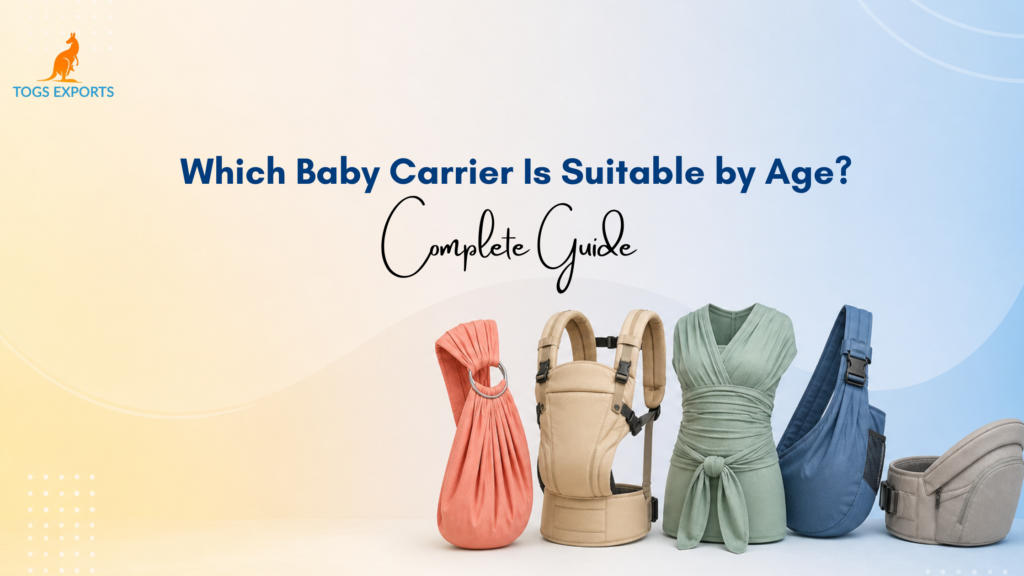
Choosing the right carrier is not only about design or comfort. It depends heavily on the baby’s age and developmental stage. Many retailers overlook this connection and focus only on product appearance. However, a well-planned Baby Carrier by Age Guide helps ensure that each product fits real usage needs. When manufacturers design carriers, they consider how the baby grows and how support requirements change over time.
Understanding age-based suitability helps retailers build a more practical product range. It also improves customer satisfaction because the product matches expectations. As a manufacturer, we focus on aligning design and production with each stage of growth. This ensures that the carrier performs correctly across different age groups.
Newborn Stage and Soft Support Requirements
Newborns require maximum support and close contact. Their body structure is still developing, so carriers must provide gentle positioning. At this stage, wrap carriers and sling carriers are commonly preferred. These designs allow the baby to stay close while maintaining flexibility.
From a manufacturing perspective, fabric selection becomes critical. Soft materials with controlled stretch help maintain comfort without losing support. This stage focuses on safety and natural positioning rather than structure. Proper production ensures that the carrier adapts to the baby’s shape without pressure.
Infant Stage and Structured Support Transition
As the baby grows, the need for structured support increases. Infants require better weight distribution and stability. This is where buckle carriers become more suitable. They provide a defined structure that supports longer carrying durations.
Manufacturers focus on panel shaping and reinforcement during this stage. The carrier must distribute weight evenly across the shoulders and waist. This improves comfort for the caregiver while maintaining support for the baby. Structured production ensures consistency across every unit.
Baby Carrier by Age Guide for Growing Babies
A proper Baby Carrier by Age Guide helps retailers understand how product suitability changes over time. As babies become more active, carriers must allow movement while maintaining stability. Sling carriers and adjustable designs are often used in this stage.
Manufacturing focuses on flexibility combined with strength. The carrier must adapt to different positions without losing structure. This balance ensures that the product remains usable as the baby grows. Retailers benefit from offering products that match this transition phase.
Toddler Stage and Increased Weight Support
Toddlers require carriers that handle higher weights and active movement. At this stage, durability becomes a key factor. Structured carriers and toddler carriers are designed to support increased load without compromising comfort.
Manufacturers use stronger materials and reinforced stitching for this stage. The carrier must maintain its shape even with continuous use. Proper production systems ensure that the product performs consistently across all batches. This improves long-term reliability.
Why Age-Based Selection Matters for Retailers
Retailers who follow a Baby Carrier by Age Guide can create a more effective product range. Each carrier serves a specific purpose, and understanding this helps reduce customer confusion. It also improves product performance in real usage.
At Togs Exports, we design carriers based on age-specific requirements. Our manufacturing approach ensures that each product aligns with the correct stage of growth. This helps retailers offer reliable products that meet customer expectations.
If you are planning to build your product range based on age suitability and want to work with an experienced manufacturer, we would be glad to discuss your requirements.
Phone: +91 99447 50075
Website: www.togsexports.com
FAQ:
- Why is age important when choosing a baby carrier?
Age determines the level of support required, including head, neck, and weight distribution. - Which carrier is best for newborns?
Wrap carriers and sling carriers are suitable because they provide soft support and close contact. - When should structured carriers be used?
Structured carriers are suitable from the infant stage when the baby needs more support. - Are toddler carriers different from infant carriers?
Yes, toddler carriers are designed for higher weight and require stronger materials and construction. - How does manufacturing affect age suitability?
Manufacturing ensures that each carrier provides the correct structure, flexibility, and durability for each stage.