
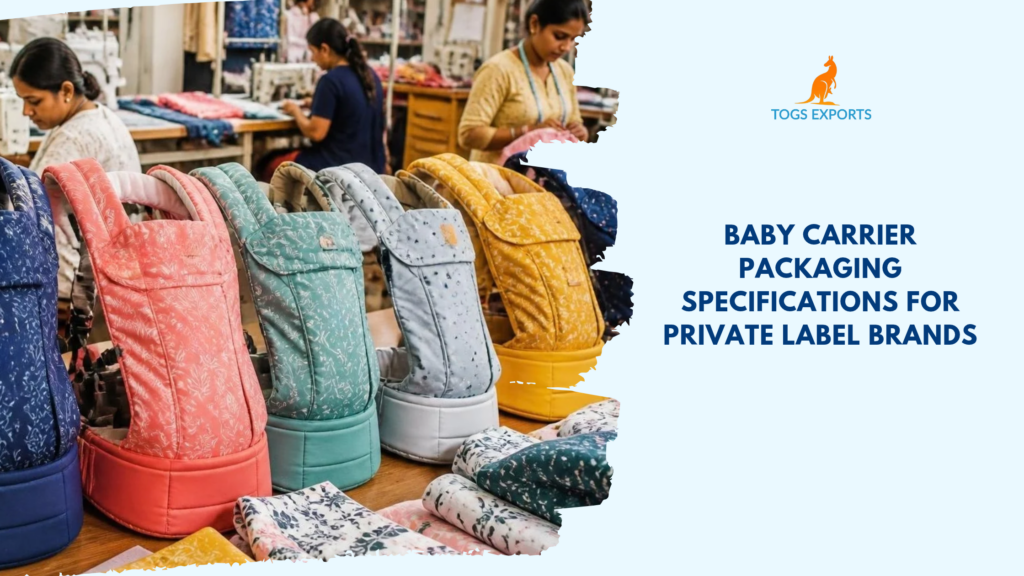
A well-designed baby carrier can lose its impact if the packaging arrives damaged, looks inconsistent with the brand, or makes the product difficult to understand. For private label brands, packaging is not simply a way to protect the carrier during shipping. It is part of the product experience, retail presentation, and manufacturing process.
That is why clear baby carrier packaging specifications should be defined before production begins. A good specification tells the manufacturer exactly how the carrier should be folded, packed, labelled, protected, and prepared for shipment.
For brands involved in baby carrier manufacturing, planning packaging early can also prevent last-minute changes that affect product dimensions, carton quantities, shipping costs, and production timelines.
Packaging Starts With the Finished Product
Packaging should never be designed separately from the carrier.
The final carrier dimensions, folding method, accessories, padding, fabric thickness, and included components all influence the packaging requirements.
For example, a structured buckle carrier may occupy more space than a lightweight wrap carrier. A carrier with a hood, storage pouch, or additional accessories may also need a different packing configuration.
Therefore, baby carrier packaging specifications should be developed after the product construction and folding method are reasonably established.
This allows the brand and manufacturer to determine the actual packed dimensions instead of estimating them from the unfolded product.
Define the Primary Packaging Format
Private label brands can use different packaging formats depending on their sales channel and positioning.
Common options include:
- Printed retail boxes
- Folding cartons
- Kraft boxes
- Drawstring bags
- Fabric storage bags
- Reusable pouches
- Polybags where appropriate
- Retail-ready packaging
The right option depends on whether the product will be sold online, through specialty stores, distributors, or large retail channels.
A premium carrier may require a more presentation-focused package, while a bulk B2B product may prioritize compact packing and shipping efficiency.
The packaging format should therefore support the brand’s positioning without creating unnecessary cost or material usage.
Include Exact Packaging Dimensions
One of the most important parts of baby carrier packaging specifications is the finished package size.
The specification should identify:
- Length
- Width
- Height
- Product weight
- Packaging weight
- Total packed weight
- Accessories included
- Number of units per carton
These details help the manufacturer prepare accurate packaging and help the buyer plan warehousing, shipping, and retail requirements.
They also become important when brands calculate freight costs.
A small change in packaging dimensions can affect how many cartons fit into a shipment, so packaging should not be treated as an afterthought.
Folding Instructions Need to Be Clear
A baby carrier can often be folded in more than one way.
However, different folding methods can create different package dimensions and different customer experiences.
A packaging specification can show:
- How the carrier should be positioned.
- Which straps should be adjusted.
- How accessories should be placed.
- How the carrier should be folded.
- Where the instruction materials should sit.
- How the final product should be inserted into the package.
Photos or simple diagrams can make these instructions easier for the production team to follow.
During baby carrier manufacturing, consistent folding also helps maintain a uniform appearance across packed units.
Protect the Product Without Over-Packing It
Packaging has two jobs: presentation and protection.
The carrier should reach the customer without unnecessary crushing, contamination, moisture exposure, or damage to the fabric and hardware.
However, adding excessive packaging can increase material consumption, package dimensions, and shipping costs.
A better approach is to identify the actual protection required for the carrier.
For example, brands may need to consider:
- Protection for buckles
- Fabric surface protection
- Protection from dust and moisture
- Prevention of strap tangling
- Protection of printed packaging
- Secure placement of accessories
The packaging solution should protect the product while remaining practical for production and shipping.
Branding Details Should Be Documented
Private label packaging needs more than a logo file.
The baby carrier packaging specifications should clearly document the brand requirements, including:
- Logo position
- Logo dimensions
- Brand colours
- Typography
- Product name
- Model or SKU
- Barcode
- Website
- Contact information
- Country-of-origin information where applicable
- Required product information
- Packaging artwork version
Providing these details in one specification reduces confusion during artwork development and production.
It also helps prevent a common problem: the physical packaging being produced from an outdated artwork file.
Product Information Needs Careful Planning
Packaging may need to communicate important information about the product.
Depending on the product and destination market, this may include:
- Product description
- Size or intended use
- Material information
- Care instructions
- Warning information
- User instructions
- Manufacturer information
- Importer or distributor information
- Barcode or SKU
- Applicable markings
The exact information required can vary by product and market.
Therefore, brands should identify their destination-market requirements before finalizing artwork rather than assuming that one packaging design will automatically satisfy every market.
For products sold internationally, regulatory and labelling requirements should be reviewed with the appropriate compliance specialists where necessary.
Instruction Materials Should Be Planned With Packaging
Baby carriers may require user instructions, especially where the design includes adjustment systems, multiple carrying positions, or specific usage guidance.
Instructions can be provided through:
- Printed manuals
- Folded instruction sheets
- Quick-start cards
- QR codes linking to digital instructions
- Product information cards
The chosen format should fit naturally within the package.
For example, if a manual is too large, it may affect the folding method or create unnecessary package thickness.
This is another reason why packaging planning should happen during product development rather than immediately before production.
Packaging and Accessories Should Have Their Own Specification
A carrier may include additional items such as:
- Storage bags
- Hoods
- Drool pads
- Waist belt accessories
- Replacement components
- Instruction manuals
- Product cards
Each item needs a defined packing position.
A packaging specification can include a simple packing sequence:
Carrier → Accessories → Instructions → Inner packaging → Retail package
This makes the production team’s job easier and helps ensure every finished unit contains the correct components.
Carton Specifications Matter for Export Orders
Retail packaging is only one part of the process.
For international baby carrier manufacturing, brands also need to consider the outer shipping carton.
A carton specification can include:
- Carton dimensions
- Units per carton
- Gross weight
- Net weight
- Carton material
- Carton markings
- SKU identification
- Shipping marks
- Barcode requirements
- Palletization requirements where applicable
These details help the manufacturer prepare the shipment correctly and help the buyer plan warehouse receiving.
They can also influence freight efficiency.
For example, changing the retail package dimensions may reduce the number of units that fit into an outer carton. That can increase the number of cartons required for the same order quantity.
Packaging Should Be Tested Before Bulk Production
Never approve packaging only from an artwork file.
A physical packaging sample should be checked with the actual finished carrier inside it.
Review:
Fit: Does the carrier fit correctly?
Protection: Does the package protect the product?
Appearance: Does the finished package look like the approved artwork?
Information: Is all required information present and readable?
Folding: Does the carrier fit using the approved folding method?
Accessories: Are all components included?
Carton packing: Does the approved number of units fit properly?
This physical check can reveal problems that are impossible to see on a computer screen.
Packaging Changes Can Affect Production
A change that looks small on paper can have a wider impact.
For example, increasing the thickness of a retail box may change:
- Packed product dimensions
- Carton quantity
- Shipping volume
- Storage requirements
- Freight calculations
- Folding instructions
- Packaging material consumption
That is why packaging changes should be recorded and approved rather than communicated informally.
During baby carrier manufacturing, maintaining a controlled packaging specification helps keep the finished product consistent from sampling through repeat orders.
A Practical Baby Carrier Packaging Checklist
Before approving packaging, brands can review:
- Packaging format selected
- Finished package dimensions confirmed
- Product folding method approved
- Packaging material specified
- Logo and artwork approved
- Product information reviewed
- Barcode and SKU confirmed
- Instructions finalized
- Accessories and packing sequence confirmed
- Retail package sample approved
- Outer carton dimensions confirmed
- Units per carton confirmed
- Gross and net weights recorded
- Carton markings approved
- Final packaging specification documented
This checklist gives both the buyer and manufacturer a common reference before bulk production starts.
How Togs Exports Supports Packaging Development
Packaging is part of the wider product-development process at Togs Exports.
For international private label brands, the packaging needs to work with the actual carrier design, accessories, folding method, branding requirements, and shipping configuration.
Our manufacturing process can support brands from product development and sampling through OEM, ODM, private label production, quality inspection, and export preparation.
For brands planning baby carrier manufacturing, discussing packaging during the development stage can make the transition to bulk production much smoother.
The best packaging is not necessarily the most expensive one. It is the one that protects the product, represents the brand properly, works efficiently in production, and makes sense for the intended market.
FAQs
1. What should baby carrier packaging specifications include?
Baby carrier packaging specifications should cover the packaging format, dimensions, materials, folding method, branding, product information, accessories, instructions, barcode requirements, carton details, and packing configuration.
2. When should packaging be finalized for a baby carrier?
Packaging should be developed after the carrier design and folding method are sufficiently finalized, but before bulk production. This allows the package to be tested with the actual product.
3. What packaging is commonly used for private label baby carriers?
Private label brands may use retail boxes, folding cartons, fabric bags, reusable pouches, or other packaging formats depending on their brand positioning, sales channel, and market requirements.
4. Does packaging affect baby carrier shipping costs?
Yes. Package dimensions, weight, carton size, and units per carton can influence shipping volume and freight efficiency, especially for international orders.
5. Can baby carrier packaging be customized with a brand logo?
Yes. Private label packaging can typically be customized with brand artwork, colours, product information, labels, barcodes, and other approved branding elements, subject to the chosen packaging format and production requirements.