
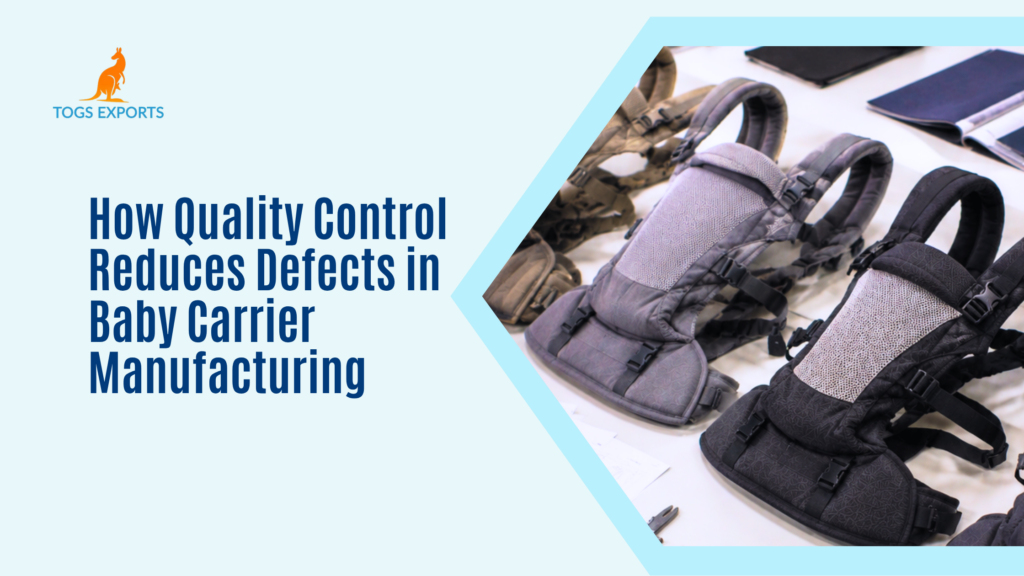
The quality of a baby carrier is determined throughout the manufacturing process, not only during the final inspection. Every production stage, from fabric preparation to stitching and assembly, influences the finished product. This is why Baby Carrier Quality Control plays an essential role in maintaining consistency and reducing manufacturing defects before products reach retailers.
Retailers depend on manufacturers who can deliver the same quality across every shipment. Even minor variations can affect customer confidence and increase product returns. At Togs Exports, quality control is integrated into every production stage, allowing us to identify issues early and maintain stable manufacturing standards.
How Manufacturing Defect Prevention Improves Product Reliability
Preventing defects is more effective than correcting them after production. Manufacturing Defect Prevention focuses on identifying potential issues before they become finished product problems. This proactive approach saves time while improving production efficiency.
Production teams monitor material quality, stitching accuracy, panel alignment, and hardware placement throughout manufacturing. Through Manufacturing Defect Prevention, small inconsistencies are corrected immediately rather than passing to the next production stage.
Early intervention also reduces unnecessary rework and material waste. This creates a more efficient manufacturing process while helping retailers receive products that meet approved specifications.
Why Quality Assurance Process Supports Consistent Manufacturing
Consistency depends on having clear standards for every production stage. A structured Quality Assurance Process ensures that each department follows approved manufacturing procedures from start to finish.
Quality assurance includes checking production methods, monitoring workmanship, and verifying that every stage meets predefined requirements. During the Quality Assurance Process, manufacturers compare production results with approved standards to maintain uniform output.
This systematic approach improves communication between departments because everyone follows the same quality expectations. As a result, manufacturing becomes more predictable and repeatable.
How Production Quality Monitoring Maintains Standards
Manufacturing quality should be monitored continuously rather than only at the end of production. Production Quality Monitoring allows manufacturers to evaluate performance throughout cutting, stitching, assembly, and finishing.
Supervisors review production activities at regular intervals to ensure quality standards remain consistent. Through Production Quality Monitoring, manufacturers can identify trends and resolve recurring issues before they affect larger production batches.
Continuous monitoring also supports long-term improvement. Production teams gain valuable feedback that helps refine manufacturing methods while maintaining product consistency.
How Baby Carrier Quality Control Builds Better Manufacturing Systems
A structured Baby Carrier Quality Control system creates confidence at every stage of production. It connects defect prevention, quality assurance, and continuous monitoring into one organised workflow that supports reliable manufacturing.
At Togs Exports, we combine Manufacturing Defect Prevention, a disciplined Quality Assurance Process, and detailed Production Quality Monitoring to strengthen every stage of production. Rather than depending only on final inspections, we focus on preventing issues before they reach finished products.
This manufacturing approach helps us deliver baby carriers that consistently meet approved quality standards. It also allows retailers to receive products that match previous orders with greater accuracy and reliability.
Why Retailers Value Manufacturers With Strong Quality Control
Retailers need manufacturing partners who consistently produce dependable products. A well-structured Baby Carrier Quality Control system helps reduce quality concerns while supporting long-term business relationships built on trust.
Manufacturers who invest in quality control provide greater transparency throughout production. Retailers gain confidence because products are monitored from raw material preparation through final packaging instead of relying on a single inspection stage.
At Togs Exports, quality control is part of our manufacturing culture. Every process is designed to improve consistency, reduce defects, and ensure that every baby carrier reflects the same production standards before it leaves our facility.
If you are looking for a manufacturing partner with structured quality control systems and consistent production standards, we would be glad to discuss your requirements.
Phone: +91 99447 50075
Website: www.togsexports.com
FAQ
1. What is baby carrier quality control?
Baby Carrier Quality Control is a structured system that monitors manufacturing at every stage to maintain consistent product quality and reduce defects.
2. How does manufacturing defect prevention improve production?
Manufacturing Defect Prevention identifies and corrects issues early, reducing rework and improving manufacturing efficiency.
3. What is the difference between quality control and quality assurance?
A Quality Assurance Process focuses on preventing problems through standardised procedures, while quality control verifies that products meet those standards during production.
4. Why is production quality monitoring important?
Production Quality Monitoring helps manufacturers identify variations early and maintain consistent quality across every production batch.
5. Why do retailers prefer manufacturers with strong quality control systems?
Strong quality control improves product consistency, reduces defects, supports reliable deliveries, and helps retailers build customer confidence.