
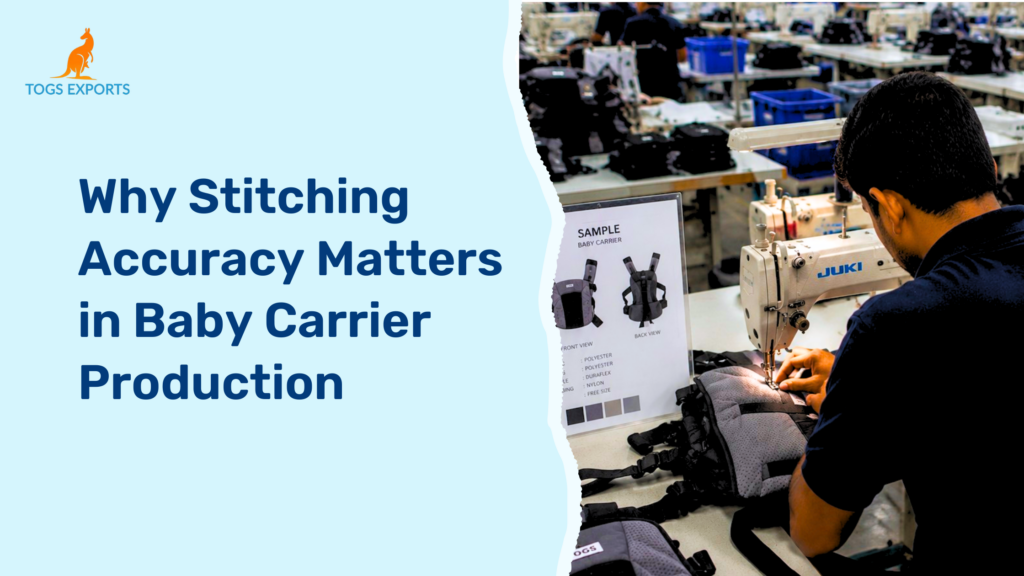
A baby carrier depends heavily on stitching strength and alignment. Even when high-quality fabrics and components are used, poor stitching can affect the entire product structure. This is why stitching accuracy remains one of the most important areas in manufacturing. A controlled Baby Carrier Stitching Accuracy process helps manufacturers maintain product durability and stable production output.
Retailers often focus on appearance during sourcing, but long-term performance depends on how the carrier is assembled internally. Structured stitching systems improve load handling, shape retention, and manufacturing consistency. At Togs Exports, stitching control forms a core part of our production workflow because it directly impacts product reliability.
How Reinforced Carrier Stitching Improves Durability
Baby carriers experience constant movement and weight pressure during daily use. Areas such as shoulder straps, waist belts, and support panels carry most of this load. Reinforced Carrier Stitching helps strengthen these stress points and improve product durability.
Manufacturers use controlled stitch density and reinforcement methods to maintain stability across the carrier structure. Through Reinforced Carrier Stitching, the product remains more secure during extended usage conditions.
This process also helps reduce structural weakening over time. Strong reinforcement improves the carrier’s ability to handle repeated movement without affecting product stability.
Why the Load-Bearing Stitch Process Supports Product Strength
Certain sections of a baby carrier handle more pressure than others. The Load Bearing Stitch Process focuses specifically on these critical areas to improve strength and balance.
Manufacturers evaluate stitch placement, tension control, and reinforcement alignment during this stage. A structured Load Bearing Stitch Process ensures that the carrier distributes weight more evenly during use.
This improves both product performance and manufacturing consistency. Stable stitch alignment also reduces the risk of uneven stress across different sections of the carrier.
How Carrier Stitching Quality Manufacturing Improves Consistency
Consistency is essential in large-scale production. Even small variations in stitching can affect how the carrier performs during actual use. Carrier Stitching Quality Manufacturing helps manufacturers maintain the same construction standards across every production batch.
Production teams monitor stitch length, seam alignment, and reinforcement accuracy throughout the workflow. Through organized Carrier Stitching Quality Manufacturing, manufacturers can reduce avoidable production inconsistencies.
This approach also improves quality control efficiency because stitching standards remain easier to evaluate during inspection stages.
How Baby Carrier Stitching Accuracy Supports Manufacturing Stability
A structured Baby Carrier Stitching Accuracy system improves both product quality and workflow efficiency. When stitching methods remain controlled, manufacturers can maintain more predictable production output.
At Togs Exports, we combine Reinforced Carrier Stitching, an organized Load Bearing Stitch Process, and stable Carrier Stitching Quality Manufacturing systems to maintain production consistency. Each stitching stage follows defined standards that support structural reliability.
This approach allows us to reduce variation across batches while improving long-term product durability. Consistent stitching also helps maintain better alignment between sampling and production stages.
Why Retailers Prefer Structured Stitching Systems
Retailers look for products that maintain their structure over time. Stable stitching systems help manufacturers produce carriers that perform consistently under regular use conditions.
Working with manufacturers who focus on Baby Carrier Stitching Accuracy gives retailers better confidence in product reliability. Structured stitching also supports cleaner finishing and improved product presentation.
At Togs Exports, we treat stitching control as an essential part of the manufacturing system rather than a simple assembly stage. Our workflow focuses on maintaining durability, structural balance, and production consistency throughout the process.
If you are looking to source baby carriers with controlled stitching systems and stable manufacturing standards, we would be glad to discuss your requirements.
Phone: +91 99447 50075
Website: www.togsexports.com
FAQ
1. Why is stitching accuracy important in baby carriers?
Baby Carrier Stitching Accuracy helps improve durability, structure, and long-term product reliability.
2. What is reinforced carrier stitching?
Reinforced Carrier Stitching strengthens high-stress areas such as straps and support panels.
3. How does the load-bearing stitch process improve product strength?
The Load Bearing Stitch Process improves weight distribution and helps maintain structural stability.
4. What is carrier stitching quality manufacturing?
Carrier Stitching Quality Manufacturing focuses on maintaining consistent stitching standards across production batches.
5. Why do retailers prefer structured stitching systems?
Structured stitching improves product durability, consistency, and overall manufacturing reliability.