
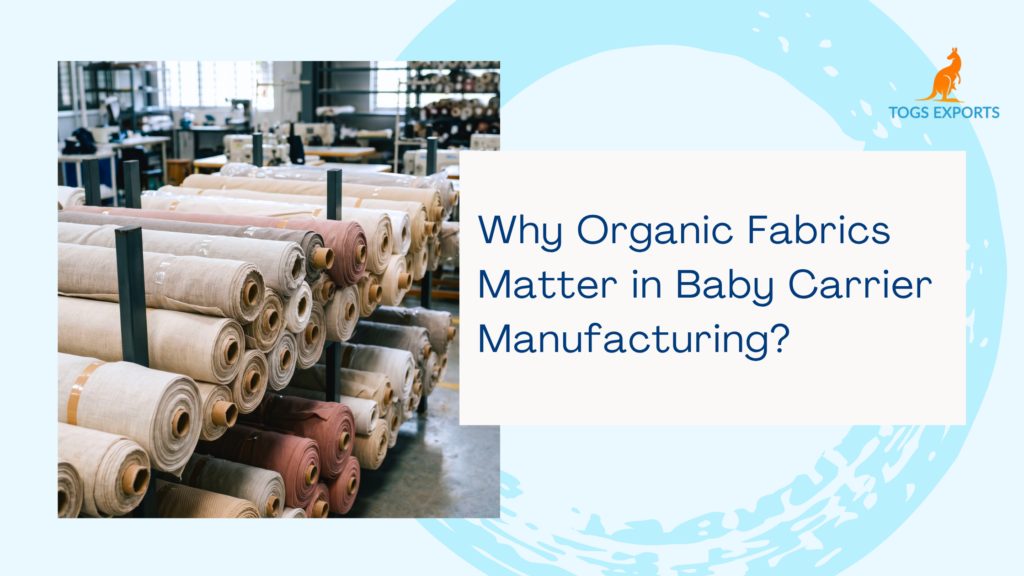
Material selection plays a major role in how a baby carrier performs during everyday use. The fabric affects comfort, flexibility, durability, and overall product stability. As retailers become more aware of sustainable production practices, interest in organic materials continues to grow. This shift has increased the importance of Organic Baby Carrier Manufacturing within modern production systems.
Organic fabrics are not chosen only for environmental reasons. They also support cleaner material handling and more controlled production processes. At Togs Exports, we focus on selecting materials that align with structured manufacturing systems while supporting long-term product reliability.
Why Organic Cotton Carrier Production Supports Product Comfort
Comfort begins with fabric quality. During Organic Cotton Carrier Production, manufacturers focus on materials that feel soft while maintaining the required strength for daily use.
Organic cotton fabrics are often used because they provide better breathability and a smoother texture. These characteristics improve usability for both babies and caregivers. Through Organic Cotton Carrier Production, manufacturers can maintain consistent material behavior during stitching and assembly.
This consistency also helps reduce variations during production. Stable fabric performance allows manufacturers to maintain more predictable product output across batches.
How Sustainable Baby Carrier Materials Improve Manufacturing Stability
Production consistency depends heavily on material behavior. Sustainable Baby Carrier Materials are selected not only for environmental value but also for manufacturing reliability.
Manufacturers evaluate fabric strength, flexibility, shrinkage behavior, and compatibility with stitching before production begins. Through controlled material selection, Sustainable Baby Carrier Materials help improve workflow stability throughout the manufacturing process.
This approach also reduces material-related production issues. Retailers benefit because the final product maintains better consistency during long-term use.
Why Eco-Friendly Carrier Manufacturing Requires Structured Processes
Using sustainable materials alone does not create stable production. Manufacturers must also adapt their workflow systems to handle these materials properly. Eco-Friendly Carrier Manufacturing focuses on maintaining controlled production methods while working with organic and sustainable fabrics.
This includes fabric storage, cutting accuracy, stitching control, and finishing methods. During Eco-Friendly Carrier Manufacturing, production teams monitor how materials respond at each stage of assembly.
Structured handling improves production consistency and helps reduce avoidable waste during manufacturing. It also supports better workflow organization across departments.
How Organic Baby Carrier Manufacturing Supports Long-Term Production Quality
A stable Organic Baby Carrier Manufacturing system creates better alignment between material quality and production consistency. Manufacturers can maintain more predictable results when fabrics behave consistently during production.
At Togs Exports, we combine Organic Cotton Carrier Production, controlled Sustainable Baby Carrier Materials, and organized Eco Friendly Carrier Manufacturing systems to support stable manufacturing workflows. Each stage focuses on maintaining both product quality and production clarity.
This approach helps us improve consistency across batches while supporting responsible material usage. Retailers gain better confidence in the product because the manufacturing process remains structured from material selection to final assembly.
Why Retailers Prefer Organic Material Manufacturing Systems
Retailers today pay closer attention to how products are manufactured and what materials are used during production. Structured Organic Baby Carrier Manufacturing systems help retailers offer products that align with evolving customer expectations.
Organic and sustainable materials also improve transparency within the manufacturing workflow. Retailers can better understand how fabrics are selected, processed, and integrated into final production.
At Togs Exports, we focus on maintaining manufacturing systems that combine structured production with responsible material handling. Our approach supports both manufacturing consistency and practical product development.
If you are planning to develop baby carrier products using sustainable and organic materials, we would be glad to discuss your requirements.
Phone: +91 99447 50075
Website: www.togsexports.com
FAQ
1. What is organic baby carrier manufacturing?
Organic Baby Carrier Manufacturing involves producing baby carriers using organic and responsibly sourced materials within controlled manufacturing systems.
2. Why is organic cotton used in baby carriers?
Organic Cotton Carrier Production helps improve comfort, breathability, and material consistency during manufacturing.
3. How do sustainable materials affect production quality?
Sustainable Baby Carrier Materials provide stable fabric behavior that supports consistent manufacturing output.
4. What is eco-friendly carrier manufacturing?
Eco-Friendly Carrier Manufacturing focuses on organized production systems that reduce waste and support responsible material handling.
5. Why do retailers prefer organic material products?
Retailers value products made through structured and transparent manufacturing systems using sustainable materials.